|
Karol Wojtyła (John Paul II) – Hans Koechler
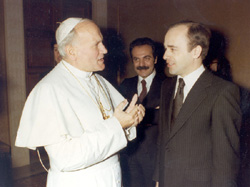
Vatican City, 26 February 1979
«
Karol Wojtyła's Notion of the Irreducible in Man and the Quest for a Just
World Order » |
|
Philosophical co-operation “Cardinal Wojtyła’s conception of man’s self-determination has been introduced to the English-speaking public by Hans Köchler …”
(Andrzej
Połtawski, “Ethical Action and Consciousness. Philosophical and
Psychiatric Perspectives,” in: Analecta Husserliana, Vol.
VII
[1978], p. 147.) The co-operation between Cardinal Wojtyła and Hans Koechler lasted from 1974 until 1979. It was related to basic issues of phenomenology (a philosophical method established by Husserl and Heidegger) and phenomenological anthropology. At the time, both philosophers were members of the World Phenomenology Institute headed by Prof. Anna-Teresa Tymieniecka (USA). In 1975, Dr. Koechler presented a companion paper to Cardinal Wojtyła’s lecture “Participation or Alienation” at an international phenomenological colloquium in Fribourg (Switzerland). The Cardinal was unable to attend in person, so he provided Dr. Koechler with unpublished manuscripts on the basis of which the latter wrote the first introduction and commentary into the later Pope’s phenomenological philosophy.
The co-operation that followed
is documented in an exchange of correspondence and in philosophical
literature some of which is listed below. |
|
Article by Karol Wojtyła “Participation or Alienation?” in: Analecta Husserliana, Vol. VI (1977), pp. 61-73: “I wish to add my considerations to those of all other speakers at this Fribourg Colloquium on the theme, ‘Soi et autrui.’ Having been honored by an invitation to participate in this Colloquium, I can contribute unfortunately only this written piece of work … In a special way I wish to thank … Dr. H. Köchler, who undertook to write a companion paper related to mine.*
*See Dr. H.
Köchler’s ‘Die dialektische Konzeption der Selbstbestimmung.’
(Einige
Überlegungen zum systematischen Ansatz von Karol Wojtyła).
The author had at his disposal in preparing his companion-paper only two
texts which I was able to make available to him. Those were: ‘The Personal
Structure of Self-Determination’ published in the volume Tommaso
d’Aquino nel suo VII centenario – Congresso Internazionale Roma-Napoli,
17-24 aprile, 1974; also, a French translation of the last two paragraphs
from the book, Osoba i Czyn, Polskie Towarzystwo Teologiczne,
Kraków 1969. At present the book itself is available only in the original
Polish. …” |
|
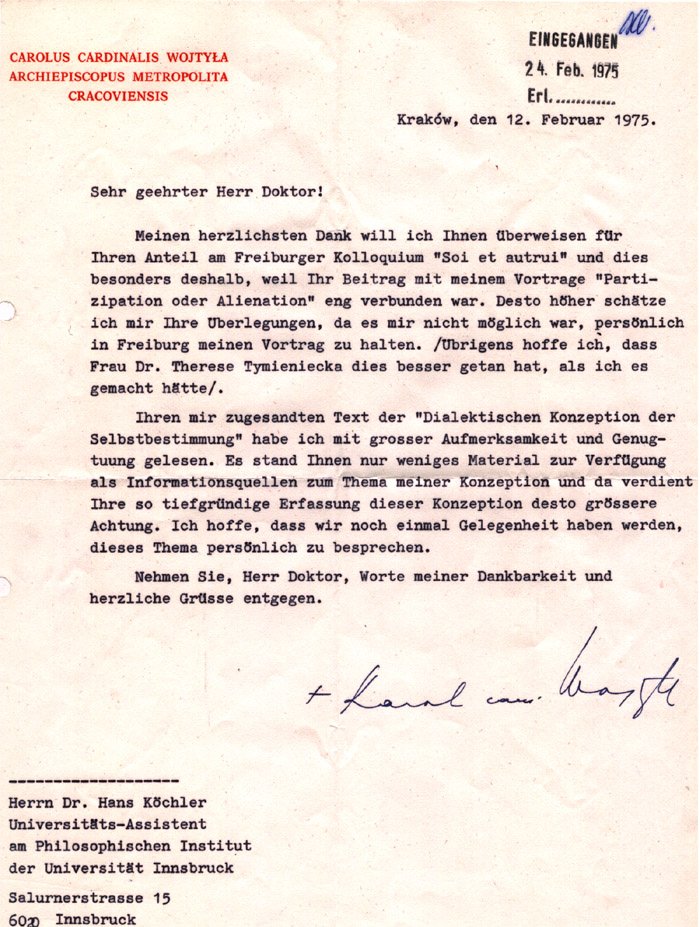
Karol Wojtyła’s letter to Hans Koechler, dated 12 February 1975 (excerpt)
“I extend to you my cordial thanks for your participation in the colloquium in Fribourg ‘Soi et Autrui,’ and in particular because your contribution was closely related to my lecture on ‘Participation or Alienation.’ I value your analysis even higher because I was not able to deliver my lecture in Fribourg personally. … I have read with great attention and satisfaction your text which you forwarded to me (‘The Dialectical Conception of Self-determination’). Only a limited amount of material was available to you as source of information on my conception; in view of this, your profound understanding of my conception deserves even higher respect. I hope that we shall have the opportunity some time to discuss the topic personally. Accept … words of my gratitude and cordial greetings …” (Trans. from the German original)
N.B.: the
personal meeting with John Paul II took place on 26 February 1979
at the Apostolic Palace in the Vatican – following the
Italian Phenomenology Conference in Viterbo. |
|
Secondary literature See, inter alia, Rocco Buttiglione, Karol Wojtyła: The Thought of the Man Who Became Pope John Paul II. Grand Rapids (Michigan): Wm. B. Eerdmans Publishing Co., 1997, p. 331 (this quotation gives a good summary of Hans Koechler’s interpretation): “Hans Köchler, ‘The Phenomenology of Karol Wojtyła: On the Problem of the Phenomenological Foundation of Anthropology’ (1982),* outlines Wojtyła’s position as a realist phenomenology. Wojtyła accepts that the traditional, nonphenomenological point of departure of anthropology objectifies man; his own point of departure is a phenomenological description of experience. While Wojtyła objects the cosmological point of departure as inadequate in anthropology, he does not limit anthropology to phenomenology, and points to a transphenomenological approach for a complete anthropology. Wojtyła rejects Husserl’s idealistic turn, which leads to a subjectivist reflection and absolutization of consciousness. In addition, he emphasizes the subconscious as an essential moment of the identity of the subject and the passive, non-intentional function of consciousness.
*In
Philosophy and Phenomenological Research 42 (1982), pp. 326-34.” |
|
Lectures by Hans Koechler
|
|
|